

When I was a kid, I watched about as many cartoons as any kid in the 70s. So probably too many, though thanks to Schoolhouse Rock I can still recite the preamble to the Declaration of Independence, so I guess there’s that?
Anyway, the Looney Toons corpus had a character—I think he’s an abominable snowman?—who would fall in love, in a paternalistic way, with another character—Daffy Duck, in this clip—who the snowman desperately wanted to take home as a pet. He declared: “I will hold him and squeeze him and call him George.”
The snowman does hold and squeeze Daffy so hard that Daffy screams for mercy. If you’re not a Gen Xer, a similar sort of idea is echoed in this more recent movie scene, in Tommy Boy,1 though the victim is only a biscuit.
Granted, a cartoon I watched in the 70s isn’t “data,” “evidence,” or even a field observation, and when I began writing this piece I assumed there was no scholarly literature on this topic because it seemed, well, a bit silly.
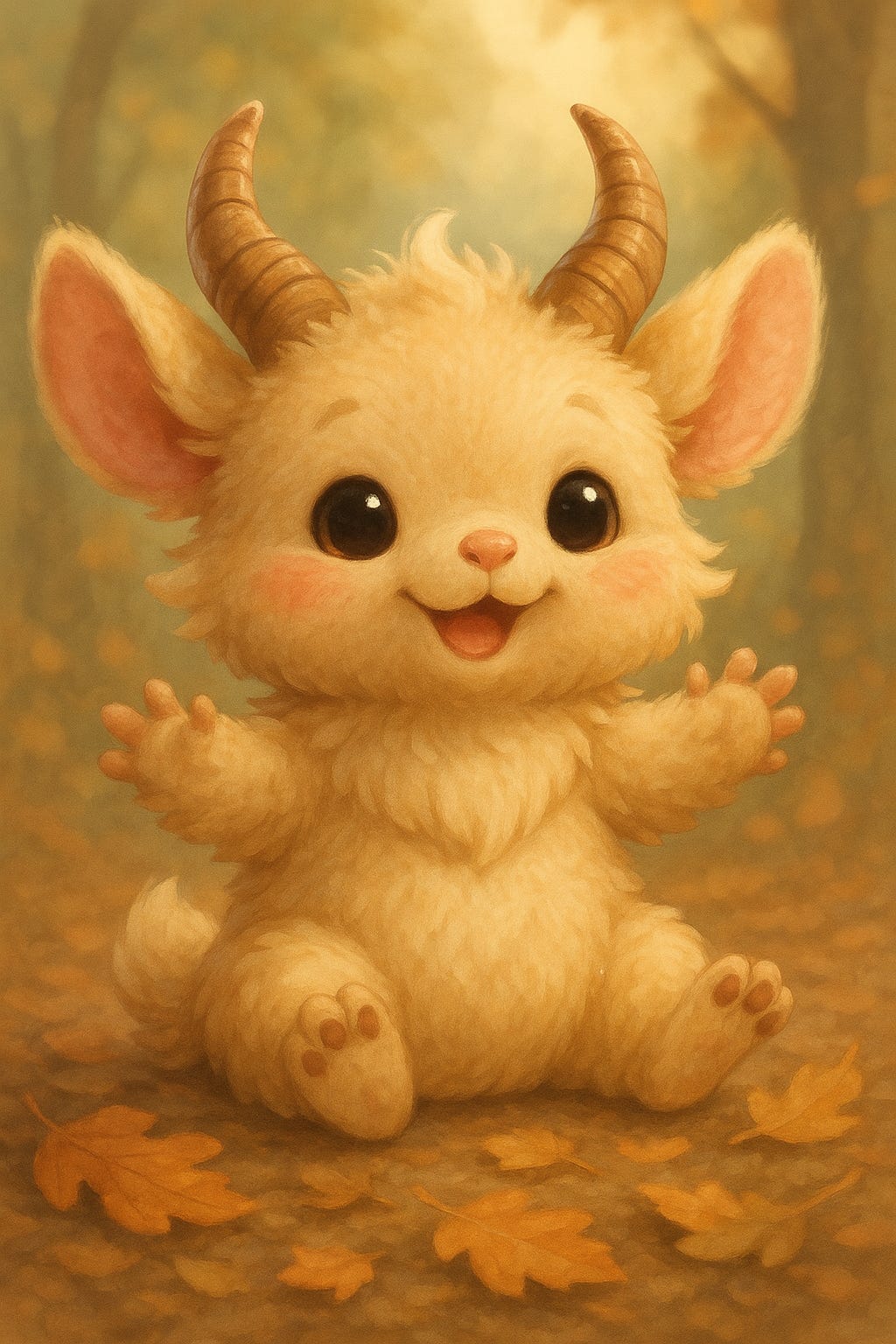
But… I mean, I do sort of feel some odd compulsion when I see a capybara, to say nothing of a blue-nosed snoot: I just want to squish the stuffing out of them. Maybe it’s just me (and the abominable snowman), but is there some human motivation to see really cute little animals and… crush them to death?
Well, surprise, it turns out there is a literature on this topic, or at least the beginnings of one. The earliest treatment I found of this was Aragón et al. (2015), which I’ll refer to as ACDB, the authors’ initials. In a pilot study, they report it isn’t just me and the abominable snowman: a significant fraction of research participants admitted to having pinched (30%) or squeezed (52%) a cute baby or child.
Not only that, but while English, as far as I know, doesn’t have a word for this feeling, ACDB report that the word gigil, in Filipino, carries this meaning. I don’t speak Filipino, but the AIs I asked about this agreed, so at least one language seems to have the term.
So, maybe it’s a Thing? ACDB dub it “cute aggression,” and since they seem to have the first paper on the topic, they should get naming rights, but when I started writing this piece I called it “cute crushing.” I’m retaining my phrase because 1) the alliteration is alluring and 2) I’m not sure that there is any genuine aggression in there.2 ACDB note that people also growl, bite, and pinch when they see massive cuteness.
So, in sum, cute crushing is the feeling that something is cute with an attendant motivation to squeeze the living crap out of it.
Before going any further, I want to be very clear I don’t really get this. I’m offering this feeling as something of a puzzle, a pattern to be explained. Not by me, necessarily, but by someone. Remember, Isaac Asimov asserted that breakthroughs happen less after an “aha” and more often after an “well that’s damn peculiar.”3
Ok, the part of this that we can explain reasonably well is the “cute” part.
This literature goes as far back as the ethologist Konrad Lorenz. As animals develop from juvenile to adult, there are, across species, predictable changes in body ratios. Take, for instance, the ratio of the size of the head to the size of the body. Paintings before the Enlightenment look funny because babies’ head-to-body ratio is too small. As humans and other animals grow, the head grows, but gets smaller relative to the size of the body. Similarly, relative to their head size, babies’ eyes are bigger and their noses are smaller. The same shift in these ratios holds for birds and other animals.4 This consistency is why you can tell if you’re looking at an adult, even if it’s a species you know nothing about. Indeed, you can tell when a fictional animal is a juvenile for the same reason. And it’s why you can tell an AI to make an obviously juvenile fictitious animal and it’ll do a creditable job.
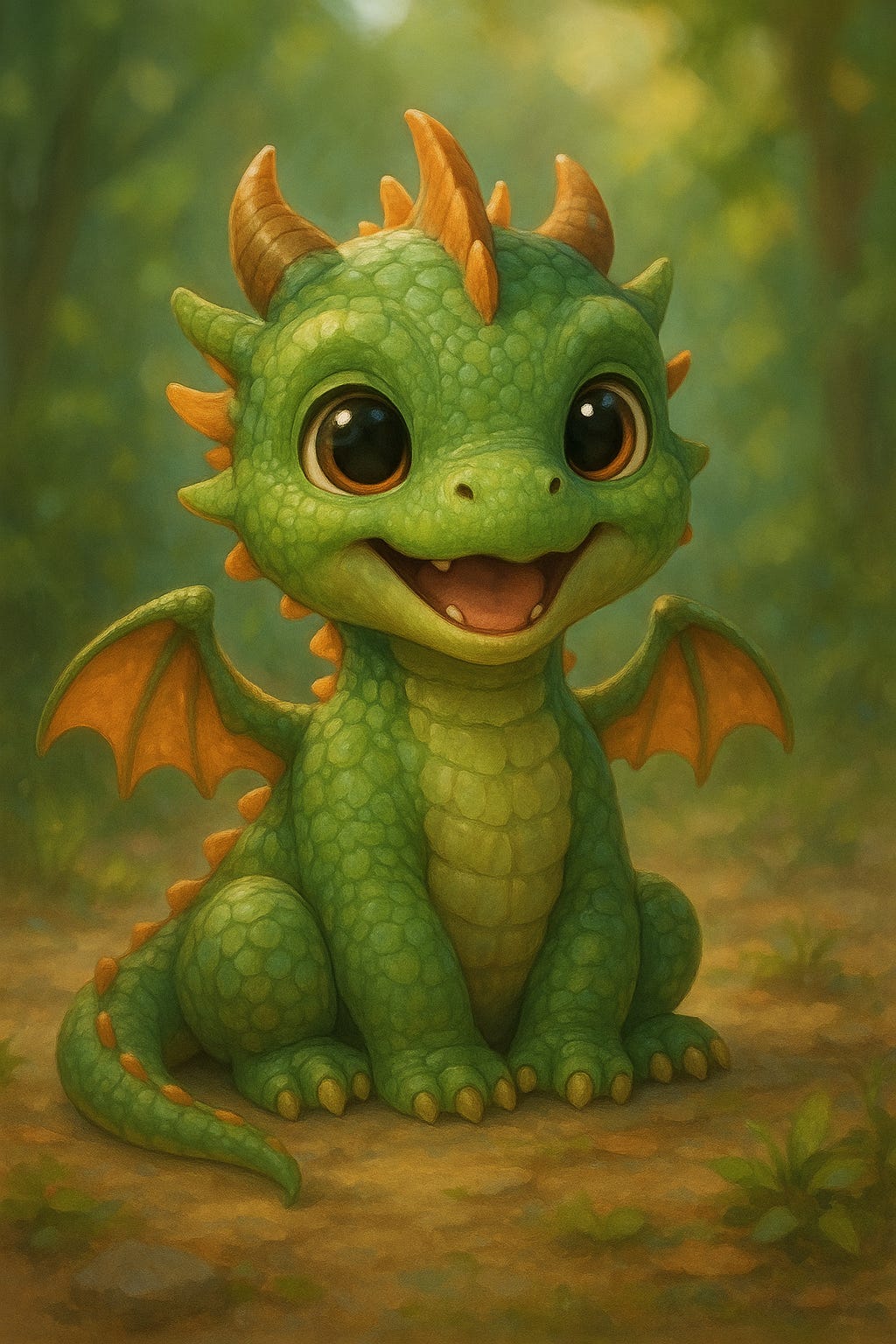
These ratios, then, contain information about where the critter is in its development. Our sense of “cuteness” is very much a measurement of whether the thing we’re looking at is a juvenile or adult. Anything with a larger-than-normal head to body ratio seems young and, therefore, cute.
Creative types use this to elicit empathy for characters. Stephen Jay Gould documented how Walt Disney’s Mickey Mouse became more young-looking over time. Mickey’s eyes became larger relative to his head and his head larger relative to his body. The old Mickey looked like a delinquent. Current Mickey looks harmless.
Under normal circumstances, cuteness motivates the sort of thing that juveniles need in order for them to make it to adulthood: protection, care, and a clean bottom. The problem with being a juvenile is that you’re fragile, can’t get your own food, and wouldn’t last a single round against a hungry wolf. The human motivation to care for cute things likely stemmed from the massive need for parental investment that our juveniles require. The cuteness motivates bearing the cost of all that protection and care.
Today, this sense of cuteness is not restricted to babies. We feel the urge to care for cute things of different species, even though doing so does not contribute to our reproductive success. This explains why Johnny brought in the injured baby chipmunk despite very explicit instructions to the contrary. We also apply the term “cute” to things that are miniature versions of something in the real world. A chair in a doll house is often “cute” because it’s a tiny tiny replica of an actual chair. Like a juvenile animal, a tiny chair is vulnerable and needs a certain amount of care to survive.
So that all makes sense. But what about the crushing part? Let’s get to some data.
ACDB presented participants with baby images that had been modified to make them extra cute and the researchers measured participants’ feelings about them, including their aggressive feelings:
For each trial that measured aggressive expressions, the phrase “When I look at this baby, I feel like” was completed by one of three phrases: “pinching those cheeks!” “saying ‘I want to eat you up!’ through gritted teeth,” or “being playfully aggressive!”
They find a small (d = 0.28) effect such that people report more feelings of aggression for the cuter babies.
So that’s interesting.
In terms of an explanation for this phenomenon broadly and these findings in particular, the authors posit a kind of emotional safety valve story. The idea is that some feelings are just so big people need to bleed off some of these feelings lest they be overwhelmed. They do this with the opposite emotion. So if you’re just so moved by watching a video of a dog reuniting with her military owner—one of my guilty pleasures when I’m taking a break—to regulate this overpowering feeling of happiness you bring in some sadness; hence the tears.
In another study, ACDB use a complex design in which they show research participants more and less cute stimuli and measure their emotions over the course of the study. They found that people who exhibited more of these ‘playfully aggressive’ reactions returned more quickly to their prior emotional baseline. The idea is that if you have some of this cute aggression, you tamp down your intense cuteness overload. That is, the cuteness aggression buffers their feelings, acting as a pressure valve for all that pent-up cuteness feeling.
So their idea is that the feeling of caring is to motivate helping the baby but the feeling of cute crushing is to keep yourself together. They summarize the key finding this way:
We found … that caretakers’ expressions of caring serve the well-being of infants (e.g., Lorenz, 1971). We also found expressions of aggression, and we presume that these expressions may help regulate emotion and support the immediate well-being of the caretaker.
The feeling of care is there for the baby and the feeling of aggression is there for you, keeping a lid on all that crazy baby-love.
I want to be very clear that this idea is better than my idea because I don’t have one.
Still, I guess my question is this. Why didn’t evolution just dial down the sense of cuteness? If seeing that much cute all bundled up in one baby is going to leave you incapacitated, why not just… not? Remember, all of these feelings and motivations had to evolve in the first place. As Don Symons says, beauty is in the adaptations of the beholder. Evolution can produce different relationship between stimuli and feeling/motivation. Doesn’t it seem odd that our response to cuteness could be so big that it paralyzes us?5
ACDB note other areas in which experiencing an intense emotion gives rise to what looks like its opposite. People shed tears of joy when intensely happy. People have been known to smile, laugh, or giggle in situations of extreme danger. So there does seem to be something of a pattern of opposites.
But even those examples aren’t exactly parallel, at least to my eye. People who are intensely happy don’t want to do the opposite of celebrating. In cute crushing, you feel the cuteness, you feel the motive to nurture… and also pop the little thing like bubble wrap. The intense tears of happiness and intense smiles of fear cases don’t strike me as exactly the same because they don’t come with the motivation to do the opposite.
Closer, I think, are reports of people having the unaccountable urge to jump when they look down from a great height. (Once again, there is a scholarly literature on this. It’s referred to as “the call of the void,” which seems a bit dramatic, or the “high place phenomenon,” which seems dry, but ok.) That seems more analogous, feeling the huge fear, and then having the sense of wanting to do the opposite of what that feeling is telling you to do, namely back away.
In addition to safety valve theory, another theory that has been offered is a cross-wiring explanation, similar to a theory put forth for foot fetishes. Some people have wondered if foot fetishes are relatively common because the nerves that project from the feet go to a part of the brain that’s right next to the part of the brain that gets signals from the genitals. It’s a sort of cross-wiring explanation. So maybe it’s a neural thing?6
Maybe.
I find those explanations somewhat unsatisfying, but sometimes unsatisfying explanations are true. Here are some other ideas.
Maybe thinking about crushing the baby or leaping off the cliff allows to you simulate what it’s like, which in turn helps you not to do it?
Maybe pinching the baby’s cheek is a bit like tickling, signaling a kind of forbearance?
Maybe it’s a weird side-effect of, well, who knows what, that got in there and natural selection couldn’t dig it out because people generally don’t crush babies or jump off cliffs?
Anyone got another idea?
CITATIONS
Aragón, O. R., Clark, M. S., Dyer, R. L., & Bargh, J. A. (2015). Dimorphous expressions of positive emotion: Displays of both care and aggression in response to cute stimuli. Psychological science, 26(3), 259-273.
Stavropoulos, K. K., & Alba, L. A. (2018). “It’s so cute I could crush it!”: Understanding neural mechanisms of cute aggression. Frontiers in behavioral neuroscience, 12, 414775.
See also the OG, Lennie Small in Of Mice and Men, for a more extreme version.
ACDB also have this view, but to me that weighs against using the term “aggression.”
Ok the Asimov quote, which might not actually be his, is “The most exciting phrase to hear in science, the one that heralds new discoveries, is not 'Eureka!' but 'That's funny...'" I guess it was Kirk who said “that’s damn peculiar” in The Wrath of Kahn.
Konrad Lorenz pioneered this idea.
Readers steeped in the psychological literature—you both know who you are—might be thinking that this line of argument sounds a bit like Terror Management Theory. When I learned of that theory, I had the same reaction, for what that’s worth.
Stavropoulos & Alba (2018), p. 14.
Yup! I can recall handling little chicks as a kid, and struggling slightly to control the urge to crush them in my hands.
Really interesting and like you, none of the explanations sound 100% convincing though any of them COULD be true.
'The call of the void' phenomenon is something I understand. If I find myself at the top of a high building I often imagine myself jumping off 'and then I involuntarily push myself back from the edge and occasionally I say, 'NO!' out loud, that comes out more like a moan. Then my entrails loosen and return to wherever it is that entrails live.
But I don't think 'the call of the void' is a good term since I get related things which have nothing to do with height or doing away with myself. For example, I used to teach English to a really nice German businessman, the manager of a large cosmetics compnay. His secretary used to bring us both a coffee while this relaxed private lesson was going on. Several times I imagined myself throwing my hot coffee all over the man's nice clean shirt, suit and tie and would mentally tell myself 'NO!' This despite being the opposite of those capitalist-hating Anti types.
There is another phenomenon that is related in my mind though maybe not in other peoples'. It is the way people often like ugly animals. My taste is for Border Collies and Golden Retrievers but some people like Boxers and other weird looking dogs. I asked one of my Japanese students about this and she said in Japanese there is a term that means cute-ugly. I don't know if she was making it up but finding some ugly things cute is not something I feel.