

Whether to have children is one of the most important decisions in a person’s life, but because it was never a decision humans had to make in the past, we don’t really have a good way of going about it. We have instincts to guide the lead-up—is this mate attractive?—and instincts to guide the aftermath—how far will I go to protect this child?—but when it comes to pausing in the middle and weighing whether to have children at all, our evolved psychology is, amazingly enough, fairly silent.
This explains why so many of the methods people have invented for tackling the question are underwhelming: there’s nothing in our biology for them to prime or leverage. They’re improvised tools trying to do a job our species never evolved to perform.
I’ve come across plenty of these methods over the last few years while trying to decide whether to have children myself and while helping clients do the same. Let’s look at a few.
Method #1: Pros/Cons List
God grace the day when we no longer have Pros and Cons lists. In the meantime, let’s try it for becoming a parent:
Surely you see the problem? It is evident from the first Pro. The list is ultimately unhelpful because the joys of parenthood are difficult, if not impossible, to grasp in advance. Prospective parents are being asked to compare apples and oranges without ever having tasted an orange. Doesn’t this make the exercise pointless?
Well, the defender of such lists says, it’s a good prompt for conversation and reflection…
Nice try.
Method #2: Being Around Other Kids
The logic here is that by spending the weekend with Bob and Brenda and their two kids in the Catskills, you and your partner can get a true taste of parenthood.
This is what we might call wrong.
Everyone with kids knows that there’s something special about your own children. (There must be some kind of explanation for this.) Thus, as lovely as Bob and Brenda’s kids might be, they won’t hold a candle to your own, which unfairly reduces the positive side of the experiment.
On the other hand, you won’t be the one changing diapers or handling tantrums. It won’t be your boobs that chafe. Hell, you might even sleep straight through the night. So, the difficulties of parenthood are unfairly portrayed, as well.
Making the entire exercise worthless.
Method #3: Inhabiting Each Side of the Decision
This technique suggests “making the decision” and then living with it for a few days, weeks, or months. Why doesn’t this work? For the same reason we’ve seen above. You don’t know what you don’t know; you can’t experience the other side until you’re actually there.
Let’s say you first inhabit not having kids. How will this change things? It won’t. Life will continue on its merry or miserable way, the only difference being that you aren’t wrestling with this huge existential question. That’s bound to feel nice, but I don’t see how it informs your decision, except to bias you in favor of not thinking—or doing—anything about it ever again.
Next, you inhabit having kids, which exposes you to all the costs (researching strollers, saving for 529s, sex scheduling) without the baby that somehow makes it all worth it. I mean, what is the most common thing parents say to nonparents? “You can’t possibly understand until you have one yourself.” Um, right.
In short, if you already know that you don’t want kids, do this method. It will make you feel good about your decision.
Method #4: Getting a Dog As a “Proxy” Child
Don’t even get me started.
Method #5: Brené Brown’s Values Method
A client alerted me to Brené Brown the other day, an academic with her own method for approaching this question. Brown suggests clarifying your core values and asking whether children align with them. “A value,” she says, “is a way of being or believing that we hold most important,” such as freedom, connection, faith, learning, or creativity. After narrowing down to two, you then ask: Would becoming a parent help me live into these values, or consistently pull me away from them?
On the surface, this seems sensible, but it is ultimately flawed for the same reason as the others: a person—and especially their values—changes fundamentally after becoming a parent. As I argued in The Existential Relief of Having Children, a parent is a chemically different person, occupying a new life stage. What kind of guide, then, are the values of their prior self?
Case in point: before my daughter, I would have ranked leisure among my top five values. Now, I hardly care about it. I mean, sure, a little more leisure would be nice…but what would be even nicer is finishing my To-Do list. Yeah, I’ve gone from someone who routinely sipped from leisure’s cup, to a pack animal marching to the drum of my To Do list—and if anything, I’m happier. Who could have predicted that?
So, another method bites the dust.
Two Kinds of Rationale
Why are all these methods fruitless? Mainly, because there is no good way to anticipate the experience of being a parent.
That said, I think the methods above suffer from a further mistake: they leverage the wrong kind of logic.
Humans use at least two forms of logic, or rationality, when making decisions:
Academic rationality is the cognitive technology developed by thinkers throughout the ages, represented by frameworks such as the scientific method, formal logic, probabilistic or Bayesian thinking, Homo economicus, and so on. This kind of reasoning is the Enlightenment’s pride and joy, and typically what people mean when they say something like “be rational.”
Ecological rationality refers to “fast and frugal” heuristics that humans evolved over their long evolutionary history. By and large, these are well-suited to the tasks and environments that regularly occurred in ancestral conditions, such as: choosing a mate, deciding what to eat, selecting friends, reciprocating favors, getting back to base, and so on.
Anyone interested in human behavior must recognize that both forms of rationality are constantly at play. For most of human history, though, ecological rationality was the only kind we needed, because it evolved—like all our traits—to fit the natural and social environments of our ancestors.
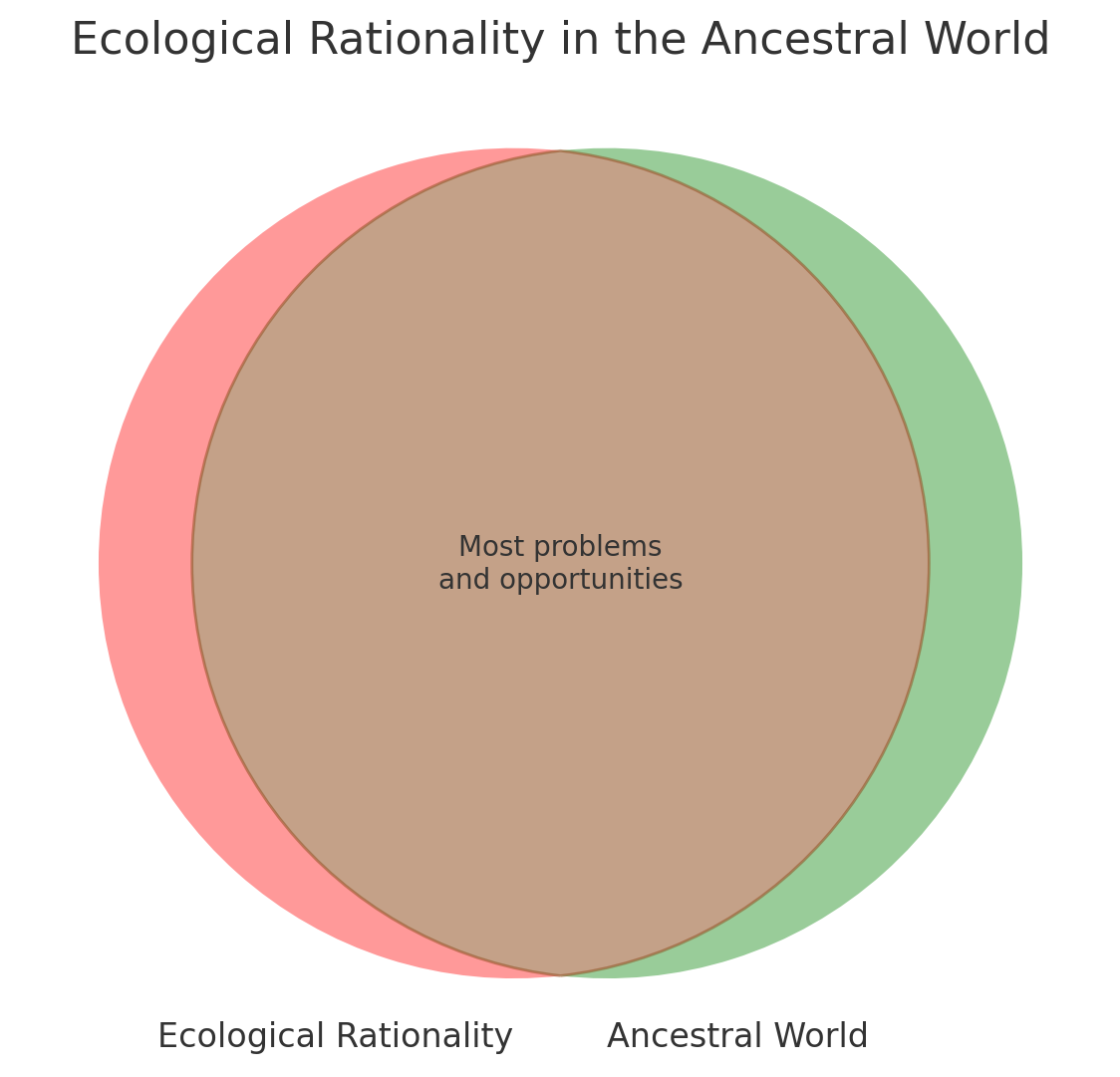
However, the modern world has changed too quickly for the slow, cumbersome process of natural selection to keep up, creating various mismatches that humans usually try to bridge with technology. One such bridge is academic rationality and its many frameworks—like the scientific method—which help modern humans, still outfitted with Stone Age minds, avoid being complete idiots.
The trick of modern life is knowing when to apply which form of rationality. All sorts of shenanigans arise when we get it wrong.
Take cognitive behavioral therapy (CBT). My main beef is that it pushes clients to use academic rationality in situations clearly governed by ecological rationality. When CBT says it’s “irrational” (or, more recently, “illogical” or “maladaptive”) to fear flying more than driving, it ignores our long evolutionary history in which tight, elevated, or uncontrollable situations really were dangerous.1 CBT therapists want clients to think probabilistically—the odds of a plane crash are far lower than a car crash—yet both therapist and client evolved to think ecologically. Ecological thinking will be especially difficult to override in moments of panic and fear, making an appeal to statistics pretty feeble, if not downright insulting.
The same mistake shows up in dating. People are often tempted to convert it into a math problem, applying academic rationality where it doesn’t belong. They reduce romance to a checklist—interests, proximity, education, politics, height. Yet if you want to make a fool of yourself, write down the qualities your future partner will have, and be specific. (Don’t just write “is attractive.” Write “has blonde hair.”) Then, when you finally meet them, read the list again. You’ll be shocked by how little of it matches. That’s a hallmark of applying the wrong kind of reasoning.
Ultimately, attraction is an ecologically rational process that draws on cues far different—and more sophisticated—than anything the fanciest dating algorithms are capturing.
Other times, ecological rationality bleeds into academic domains. Scientists provide a good example. Their job is to discover truths that hold up to academic rationality—above all, the scientific method. But scientists are also Homo sapiens, subject to temptations outside the job description: status, novelty, attention, publishable results.2 Like all humans, they’ve evolved to interpret data in ways that are adaptive but not objective. For instance, people overweight information that comes first in a sequence—a bias known as the primacy effect—so a scientist might favor the first argument they encounter, even though they’re supposed to weigh each argument equally. And then, as Daniel Kahneman observes, “once you have accepted a theory and used it as a tool in your thinking, it is extraordinarily difficult to notice its flaws.”
The long list of cognitive distortions is a testament to the many ways humans fail as scientific creatures. But this isn’t primarily a problem of training, or even of individual scientists (although better incentives could certainly help). It’s the byproduct of a species that evolved to parse reality adaptively one day deciding to pursue impersonal, objective truth—a task for which it was never built.

Of course, modern life is full of situations where people draw on both forms of rationality. Choosing a college is one example. Students put stock in how they feel on a campus tour—an ecologically rational, gut response—but also weigh academic factors (lol) like scholarships, cost, distance from home, and program strength. The same applies to choosing a major. A person may feel an inexplicable pull toward a subject while also calculating future job prospects (or lack thereof). I couldn’t really explain why I loved English and Anthropology, but I could have understood how tough the job market would be with those degrees.
Not that I ever did. Thanks for being patient, Mom and Dad.
Deciding Whether to Have Children
You’ll notice that deciding whether to have children wasn’t part of the above discussion. That’s because it’s a decision that can’t be made with academic, ecological, or even combined rationality—for the simple reason that it was never meant to be a decision at all.
For most of human history, sex naturally led to offspring. Evolution gave us the ability to decide whom to mate with and how much to protect the result—not whether to have children in the first place.
Only recently, with the invention of reliable contraception, have people been able to separate the two. We can now say, “Sure, I’d like sex, but I’m not sure about the children part.” Or even more recently: “Sure, I want children, but can I skip the sex part?” Contraception made the question possible. Unfortunately, we lack the apparatus to answer it.
This is a good time to bring in an important principle from evolutionary theory: humans have not evolved to aim directly at reproductive success. Instead, we aim at intermediate goals that correlated with reproductive success. Take sex itself. If humans wanted to maximize their reproductive success, sperm donation would be prohibitively expensive. Instead, donors get paid. Likewise, no one would bother to have protected sex; it’d be a waste of time. Instead, people have protected sex all the time because it’s enjoyable. And it’s enjoyable because it once correlated with reproduction.3
This “intermediate targeting” is what allows evolutionary mismatch to thrive. If evolution aimed directly at reproductive success, we’d all skip protected sex for the sperm donation/pick-up line. Novel technologies like contraceptives wouldn’t matter—indeed, they probably wouldn’t have been invented. But because evolution targets proxies rather than the end goal, people can be “fooled” into having protected sex—an evolutionarily pointless act—in the same way they’re fooled into raging at strangers or overeating sugar.4
In the end—or rather, in the beginning—evolution did help us. It put us in a position to successfully answer important questions like “Do I find this person attractive?” and “How much am I willing to sacrifice for this child?” But we’ve since changed the game, adding a third question for which we are poorly prepared: “Do I want children in the first place?”
The Good-As-We-Can-Get Methods
I’ve just spent over 2,000 words arguing that humans aren’t equipped to answer a question that hundreds of thousands of people answer every day. So what gives? How do people ultimately reach a conclusion about one of life’s biggest questions? In my experience, they mostly rely on the following “good as we can get” methods:
Being one of those strange creatures who always knew, one way or another. God bless ‘em.
Accident. Even today, in the richest country in the history of the world, over 40% of pregnancies are unintended. Since this closely resembles the predominant method throughout human history, perhaps it’s not so bad. That said, the costs of not being prepared are much higher in the modern world than in the ancestral one.
Culture. Parents, religion, friends, Instagram, and other social forces shape what counts as the good life. We usually treat this as a bad thing, when culture dictates terms to the individual, who ought to be making their decisions unencumbered by what anyone else thinks. As such, we’re blind to the benefits of being told what to do. Speaking for myself, I ultimately decided to have kids because my parents always presented that as what the good life entailed. They would have been disappointed if I didn’t; they would have been sad for me and for themselves. This kind of pressure is usually criticized, and sometimes rightly so, but it can also spare people from endless ambivalence. Likewise, many people feel more confident not having kids to the extent they are in touch with cultures or communities who have embraced it. Otherwise it feels like saying “the great No.”
To keep the person you love. One partner wants kids, the other wants the partner. Problem solved. This method essentially leverages a decision we are designed to make—do I love this person?—with one we are not—do I want children? Of course, it only works if one partner is confident about having (or not having) kids in the first place.
Let Us Be No Longer Confused
Ezra Klein, whom I generally respect, was once puzzled by why people aren’t having more children. In particular, he was surprised that incentive programs (like free daycare) have little effect.5
I would argue that his surprise stemmed from applying the wrong rationality. From an academic perspective, incentives drive behavior, so lowering the cost of parenthood should increase births. But it doesn’t, because people generally don’t factor these kinds of incentives into their decision. They rely on a different rubric, a different rationality.
For most of human history, that rubric was simple: Do I want to bang this person? If so, and a child resulted, the next question was: Do I want to protect this offspring? At no point did anyone have to ask whether to have children. At no point did they have to list their values and imagine “living into” them. Reproduction just happened, without deliberation.
However, now that the question is asked, it seems as if people ultimately rely on more ecologically rational approaches—Is it expected of me? Is it part of the good life as my culture understands it? Does the person I love have a stronger opinion?—rather than academically rational approaches, such as: Are there more Pros or Cons? Do I like other children? How does it feel to say yes? How about no? Ultimately, will it line up with my values? Will I receive financial aid from my government? Honestly, these questions are neither here nor there.
Even with ecologically rational approaches, though, thinking about whether to have children is still like those dreams where we go to buy something but discover there’s nothing in our pockets to pay for it (sometimes we don’t even have pants). Similarly, on this major question of life, we reach inside ourselves and find nothing, no tool made for the purpose.
One final thought:
Liberalism sees freedom and choice as the ultimate goods, but the indecision that results, especially with one of life’s biggest choices, reminds me of Rob’s point about morality: that perhaps it proved adaptive because it helped to solve a coordination problem. This raises the possibility that, in some cases, morality matters less for what it prescribes than for its ability to get everyone on the same page. Morality allows people to arrange themselves on teams before conflict occurs, which in no small measure prevents conflict from occurring.
The same goes here. It often matters less what the cultural rule is than that everyone shares it. That, finally, would be a compelling rubric: the cultural assumption that the good life either does or does not include parenthood. That assumption would return the choice of having children to what it was for most of human history: not a choice at all.
To say nothing of pressurization, which is an evolutionarily novel feeling, and therefore entirely capable of making someone nervous.
The sharpest treatment I’ve come across of academia’s many current shortcomings is Science Fictions by Stuart Ritchie, but then again, I haven’t read too much on the subject.
To be fair, it still does, just much less than it used to.
Like everything else, the ways you and I are fooled by the modern world can be separated into three buckets: good, bad, and neutral.
Financial incentives such as child credit or subsidized daycare do increase birth rates, but only modestly in the long-term. So far, they have not proven capable of reversing or stabilizing downward trends in developed countries.
Great piece!
I think the smartest thing someone ever told me is that: you can't truly ever know if you want children or not, because having children will change you, and you can't anticipate what that future version of you with children will want.
With the follow up advice that if you are about 50% sure you want children, you should just go for it, and most people don't regret it.