
Bone Shard Collection #2
On bypassing TSA and having a political opinion.


Would You Skip TSA?—JZ
If the ultimate goal of the 9/11 terrorists was to slow America down, to waste as much of our collective time as possible, they succeeded. Americans now spend, conservatively, hundreds of millions of hours per year in TSA lines, removing shoes, redistributing laptops, and explaining that the suspicious-looking item in the scanner is, in fact, a sandwich.1
In the midst of one such indignity, I had a thought: What if you could buy a “security-free” ticket? You could show up and proceed directly to your gate, arriving—just like in the old days—half an hour before departure. Of course, you’d be flying with other people who had also skipped security. Other modern safety measures, such as locked cabin doors, would remain in effect.
This is a hypothetical meant to convey a point, so don’t get lost in its feasibility. The important follow-up is: would you buy that ticket?
At first, my response was—Yes, by all means, now and forever yes. (These are the words Annie Dillard imagines the male praying mantis saying when asked whether he will mate at the cost of his head.)
But my second and final answer is—No, probably not. Especially not now that I have a daughter.
However, my becoming a dad is not the most significant factor here. 9/11 is. The events of that day showed that planes could be dangerous. Not that there was ever any real doubt beforehand, of course. We knew, in some abstract sense, that a plane in the wrong hands could become a weapon. What we lacked was a vivid example, something concrete enough to force a change. We lacked, as a psychologist would say, availability. So we did nothing—until something happened.
But here’s the thing: the risk on 9/10 was the same as the risk on 9/12—setting aside the impact of 9/11 itself2—yet we tolerated it without a second thought. Had anyone given it a second thought, we likely would have prescribed them therapy and medication for their “irrational” fear of flying.
Consider trains in the present-day United States. We “know” they could be used as weapons, but because, by and large, they haven’t been, we haven’t done much to prevent it. If something does happen, security will beef up overnight. (I can only assume nothing’s happened yet because even terrorists would prefer to avoid traveling on America’s trains.) So, for now, we buy security-free train tickets without a second thought, just as we bought plane tickets before 9/11.
The point is that we are often unaware of the risks we tolerate until some event changes our perception and renders what was once acceptable intolerable. This holds not only when the underlying risk remains stable, but even as it declines. After all, planes have become much safer since 9/11, independent of TSA security measures, yet my guess is that far fewer people would purchase a security-free ticket now than twenty years ago. Likewise, child abductions are far less frequent than they used to be, yet parents are more reluctant to let their kids roam.
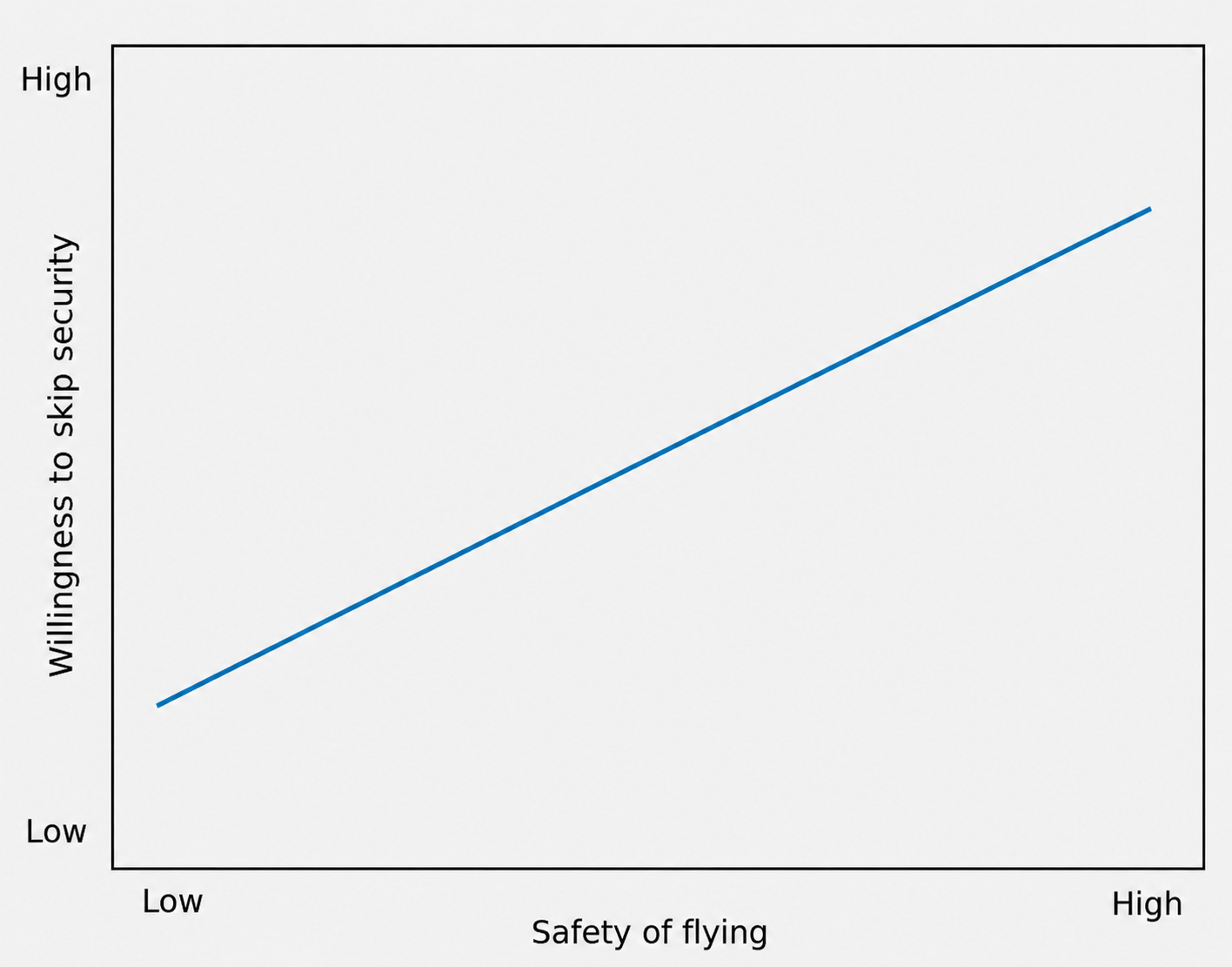
Let’s get graphic for a moment. All else equal, as the world becomes safer, we should expect people to require less protection. Travelers should become more willing to forgo TSA security as planes become safer; parents should become more willing to allow independence as child abductions decline.
The graph should look like this:
Instead, it looks like this:
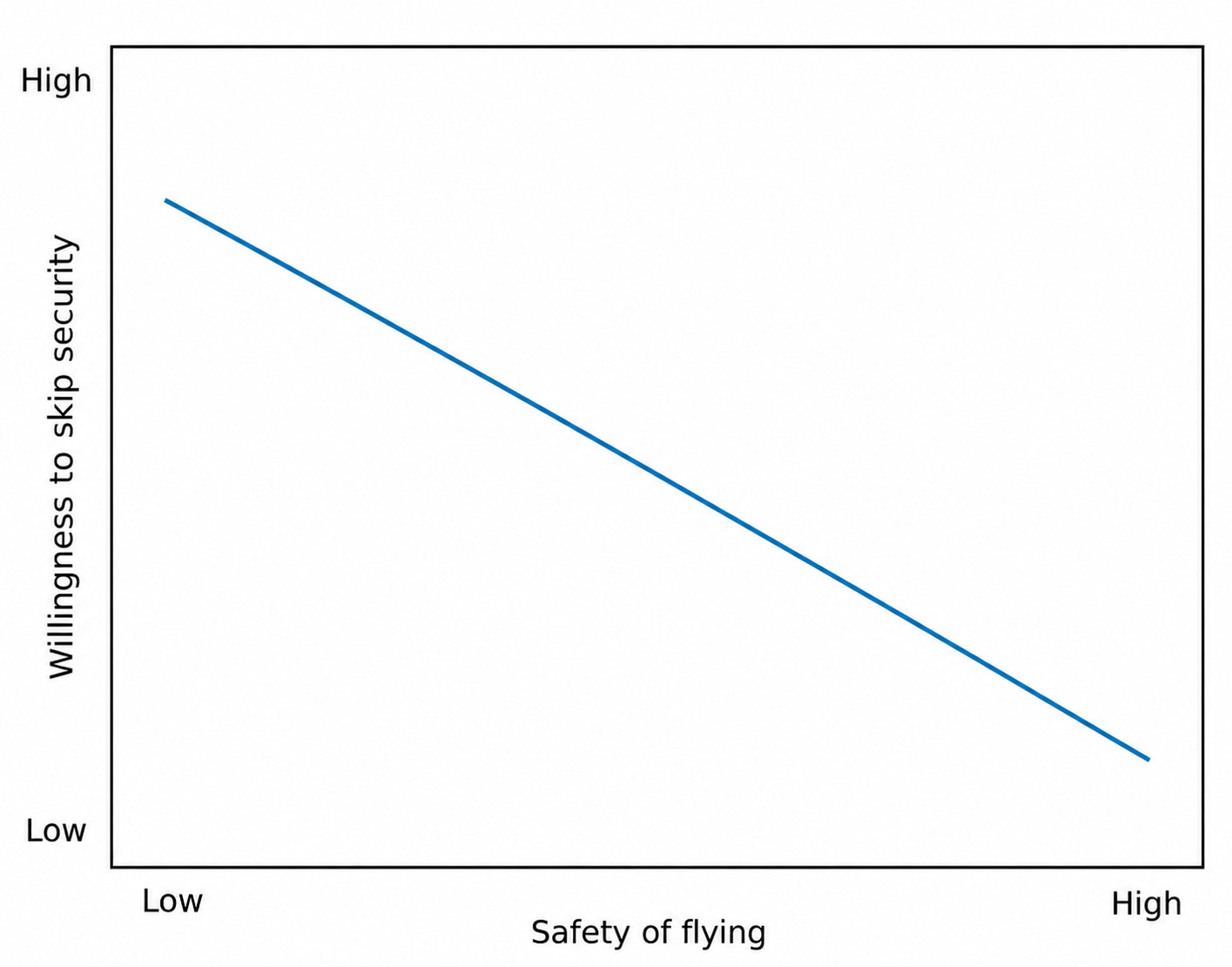
The difference between what we should see and what we do see arises because objective risk and perceived risk can move in opposite directions. The world may become safer even as it feels more dangerous.
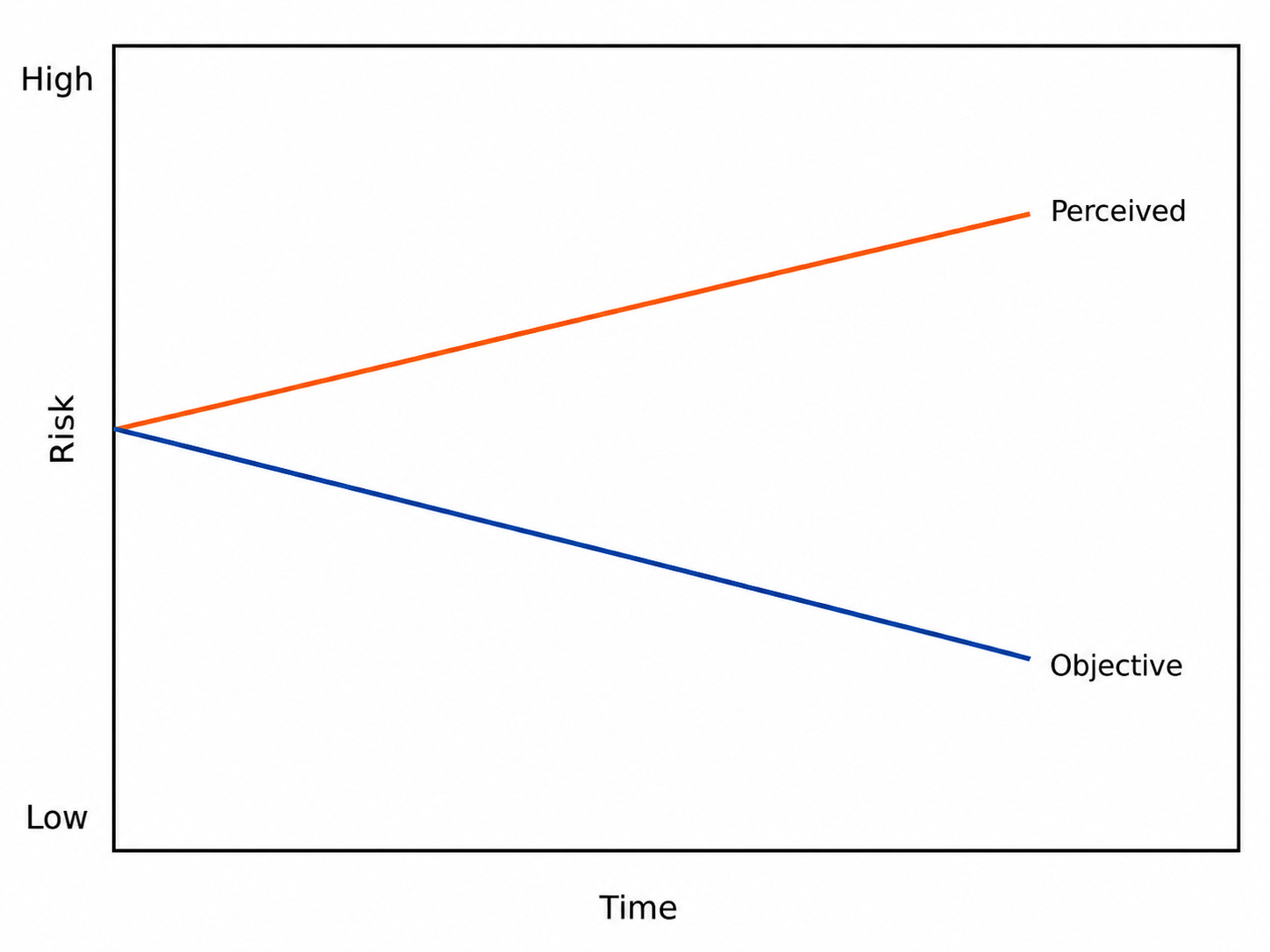
What might cause this divergence? Availability, or how easily a danger comes to mind. And what tends to make dangers of all kinds readily available? The modern global news infrastructure.
News, as we know, tends to focus on tragedy—it has a “disaster bias.” As more of that tragedy is brought to our attention, two things happen:
Objectively, the world gets safer as people work to reduce the likelihood of similar tragedies happening again
Subjectively, the world feels more dangerous because people now have vivid examples of danger lodged in their minds
You’ll notice that technology is responsible for both sides of the coin. It makes pools safer while also bringing us stories of pool disasters. So how do we solve the problem of perception and reality being out of sync? You guessed it: more technology!
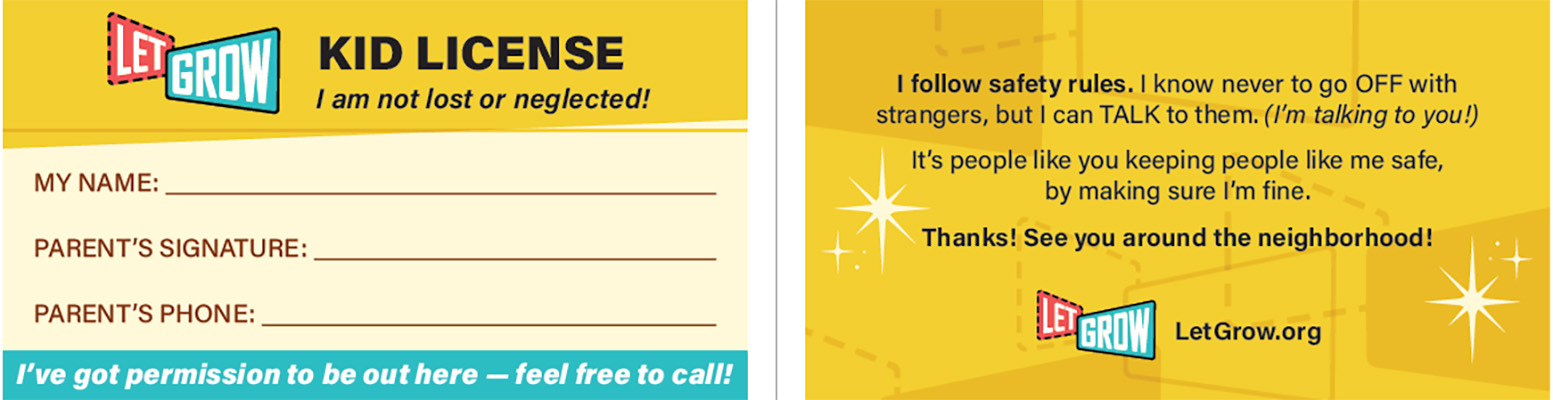
The Let Grow website, for example, tries to restore the parental confidence that several decades of true-crime television helped erode. It gives parents what they now need—research, pamphlets, even legal backing—to feel comfortable doing what a parent two generations ago would have done without a second thought: let their child go outside and play.
There’s even a Kid License!
Availability isn’t the only factor shaping our tolerance for risk. Returning to my own answer about whether I’d purchase a security-free ticket, another factor is changing stakes. Now that I have a daughter, I have more to lose and less to gain by taking risks. I am also not as young as I once was, so it may take me longer to recover from a loss. Finally, as Jean Twenge notes in Generations, it’s rational to tolerate less risk as the world becomes safer. It was one thing for pioneers to tolerate rattlesnakes when greater dangers were afoot (sorry), but it’s now foolish for someone to wander among rattlesnakes when they don’t have to.
So there may be two forces at work: some risks feel larger because they are more available, while others become less worth taking because we no longer have to take them. The open question is whether, in reducing risk, we have also reduced reward.
I’m so tickled with polls that I’d like to end with one more. When I first drafted this piece, I assumed a security-free ticket would be less expensive because security is a value-add. But then my wife made a good point: many people experience security as pure inconvenience and would happily pay to skip it. What do you think?
Party Polarization—RK
Here is the way that human political psychology doesn’t work.
I go about my day and learn this and that. I listen to my parents, I read books, I take classes, that sort of thing. As I get older, I choose an Ideology with Principles, with capital letters and all that. So, you know, my Ideology is Conservative and I believe that people should pull themselves up by their own bootstraps and that the best thing the government can do is get out of the way. Or maybe I’m a Liberal and I think that the government is the solution to helping the least among us and that’s what really matters.
Or whatever.
Now, whenever someone asks me my position on a specific political issue, I consult my Ideology and take the position consistent with it. If I’m a Conservative and someone asks me if I believe that that government should distribute wealth from the rich to the poor, I say hell nah.
In this world, which doesn’t exist, we would see predictable patterns in data. Take, for instance, the General Social Survey, a poll that has been conducted with similar questions since the early 70s. The key pattern we would see is that people’s positions on a variety of different questions would be correlated. So, for example, people who are Ideologically Liberal would give the same answers to questions about, say, affirmative action and income redistribution—yes please to both—and people who are Ideologically Conservative would give the same answers—no thank you to both.
If ideology drove views on particular issues, we would see nice big correlations across different issues.
My former collaborator Jason Weeden over at his Substack, Charty Arps, explores such datasets and how things have changed over time.
Consider this graph from this post:
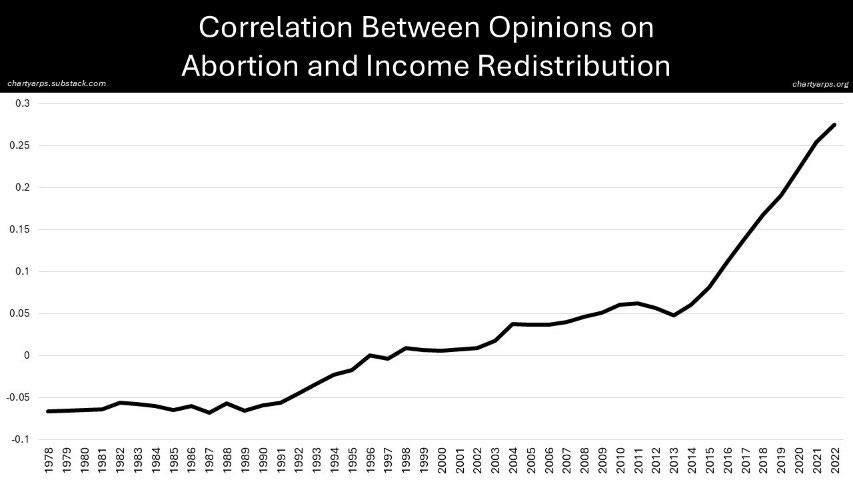
In 1996, the correlation between people’s views on abortion and income redistribution wasn’t just small, it was zero. Prior to that, it was a little bit negative. In 1996, if you asked someone their view on abortion, you would get no insight at all about their position on income redistribution. These two policy views were completely unrelated.
Here is the way that human political psychology actually works.3
When I have to take a position on some particular policy, whether because it’s put to a vote, a pollster asks me about it, the topic comes up in a conversation, or whatever, I ask myself two questions.
How does this policy affect my interests, understanding my interests to include my income, my wealth, my reproductive success, my freedom, and so forth?
What will people around me think if I adopt one position or the other?
Sometimes these two questions will point in the same direction. I’m a rich White person in Alabama in 1985 and someone asks me about my position on government wealth transfers. These transfers (1) reduce my wealth, and (2) people around me don’t like the government very much so I’m agin’ it!
Now, if I’m a poor White person in Kansas, say, then maybe that policy would help me in terms of my wealth, but I know that my neighbors oppose it. Then I have to balance the strength of the forces pulling me in opposite directions.
The power of these two considerations changes depending on the issue and the context. In some cases, I might be relatively unaffected by an issue—say I’m retired and affirmative action doesn’t really affect me one way or another—and in some cases other people might not care much about the topic in question—the trans issue in 1996, for instance.
Now, back to the graph. For some reason, starting around 2014, the correlation between people’s positions on abortion and income redistribution began to shoot up.
What might explain this?
One possibility is that ideology started driving people’s opinions. Remember that in the hypothetical world that I think doesn’t exist, people derive their specific positions from general principles.
That’s possible.
Here’s a different explanation. Around 2014, the second driver of people’s opinions—what others think about me for my positions—increased because social media made these opinions way more visible. In 1996, you couldn’t post a black square or a green circle to show which way you leaned on a topic because in 1996 people didn’t have Twitter accounts.
So, as the cost of having an opinion that differed from that of one’s community increased, the correlation between different opinions increased. More generally, as the second force—the importance of sharing the same view as others in the community—increases relative to the first force—the power of self-interest—we should expect to see more and more homogeneity in people’s political views.
Subscribe to Charty Arps for more.
No official estimate exists for total time spent in TSA lines, but with over 800 million passengers screened annually, even a conservative assumption of 10 minutes per screening yields roughly 130 million hours per year. One study suggest that post-9/11 security measures reduced air travel demand by roughly 6–9%, costing the airline industry over $1 billion.
There could be short-term increases in risk due to, say, copycat effects, but these spikes are modest and don’t alter the broader point.
I don’t really know if it works this way. It’s complicated.