
Do Eclipses Cause Rebellions?
Coordination and Common Knowledge

Ever since Darwin, a key question about the living world has been how evolution, which favors Selfish Genes, nonetheless leads to cooperation, organisms helping one another. I myself pursued this question when I was in graduate school. Later, during my four years in the wastelands of being a post-doc, two experiences brought me around to the view that coordination is at least as important an area to mine as cooperation.
The first experience was at the University of Arizona, where I was fortunate to collaborate with Amnon Rapaport, a brilliant economist. He ran a series of experiments that were designed to imitate people’s decisions regarding whether or not to enter a market. So, suppose you’re considering opening a new paint-your-own pottery studio. Your decision of whether to enter this market will depend on how many other people are in that market. If there are too many, then all market entrants are worse off because there isn’t enough demand for every entrant. But if the number of entrants matches demand, then everyone is better off, including the people who (correctly) stayed out of a market that would have been too crowded if they joined.
To model this, he brought groups of 12 subjects into a laboratory where no communication among them was possible. The rules of the game were simple. There would be multiple rounds of play, and in each round, each subject could make one of two moves—either ENTER the fictitious market or STAY OUT. The payoffs were straightforward. They were highest when EXACTLY seven people entered and declined as the number of entrants became larger or smaller than seven.
The result was so surprising that Amnon and collaborators used the word “magic” in their scholarly publications reporting the results. Somehow, groups wind up with seven market entrants in most rounds and, further, which participants enter the market changes across rounds. Remember, there is no communication, so it’s unclear how they accomplish this feat. The best explanation, which might not be all that satisfying, is that everyone sort of decides how often they will enter the market—some more and some less—and the result is that you somehow get the optimal number of people.
The second experience was a conversation with another economist, Colin Camerer, during my time at CalTech. Our discussions brought me around to the view that coordination was at least as interesting as cooperation, if not more so. Colin, whose name is frequently whispered around the time the Nobel Prize is announced, persuaded me that understanding results such as Amnon’s could be very important for understanding human behavior, both in markets and other contexts.
And then came my student, Peter DeScioli, who persuaded me that the key to unlocking the mysteries of morality lay not in cooperation, as most people at the time believed, but in coordination.
One more historical note and then on to the meat of the post and the answer to the question in the title. Thomas Schelling, in The Strategy of Conflict, was interested in how people choose strategies in coordination games. The classic example is that you and a stranger get a reward if you manage—without any communication between you—to be at the same place at the same time tomorrow in New York City. Many people pick Grand Central Station at noon. The time and the location stand out. They are “focal points,” a solution that feels not only obvious, but obvious in a way that others will find it obvious. People use these sorts of obvious solutions to try to solve any number of coordination problems. They might be obvious because they are unique, famous, or related to a cultural convention.
Ok, on to eclipses.
A solar eclipse occurs when the moon passes between the earth and the sun. So the earth is in the moon’s shadow. Depending on the details, the moon might block some or all of the sun. When the moon—or the observer—is positioned just right, the moon blocks the sun completely, a condition referred to as “totality.”
A recent paper (by Miao et al.) reports an analysis having to do with how often areas rebelled over the course of centuries of Chinese history. Do provinces in which people see total eclipses more rebel more often?
It turns out that they do.
And it’s not a tiny effect. The researchers pin down how much more likely this is, writing that “counties in the totality zone of a solar eclipse are about 18 percent more likely to experience a rebellion in the eclipse year relative to counties that are outside of the totality zone.”
Just to put that into modern context, one might wonder which has a bigger effect on rebellions, eclipses or the massive social media platform in modern China, Weibo. Qin et al. looked at exactly this question. They find an effect similar to the one that eclipses produce: “We estimate that, because of Weibo, the occurrence of a protest in one city increases the probability of a protest taking place within two days in any of the other cities by 17%.”
So, eclipses are a tiny bit more powerful than social media.
How can this be?
Now, everyone knows that you can’t logically infer causality from a correlation—in this case, between rebellions and the frequency of total eclipses.
Still, it’s not that easy to come up with a third variable that might cause both. What terrestrial force could move the moon? The authors do run through some other possibilities, including the idea that those regions differ in some way due to their climate or history, but the finding is robust to these possible confounds.
So what’s going on?
If a bunch of people want to rebel, there are two different but related problems: a public goods problem and a coordination problem.
The public goods problem rests on the decision each potential rebel faces. There is danger in rebelling, and each person would like to enjoy the benefits of a successful rebellion without putting themselves at risk. This problem is difficult to overcome, especially when the cost of participating is the possibility of death. So everyone wants others to rebel without having to take part.
The public goods problem is easier to solve as the number of participants in the rebellion increases. As the crowd increases, each person is less likely to be hurt. Greater numbers increase the chance of winning, and larger forces are likely to sustain fewer casualties in combat. So the trick is to get everyone out and protesting in the same place at the same time. They need to coordinate, not unlike the cicadas I’ve discussed in the past.
Which brings us back to Thomas Schelling.
One of my favorite lines from Les Miserables, the musical, is in the song “Red and Black.” It’s about coordination:
We need a sign
To rally the people
To call them to arms
To bring them in line!
Schelling points are all about these signs. This plugs into the argument in Steve Pinker’s new book, When Everyone Knows That Everyone Knows. There are three rungs to the knowledge ladder.
1. I know a thing.
2. I know that you know the thing.
3. I know that you know that I and everyone else knows the thing.
The importance of the second and third levels explains the usefulness of very visible events. Very visible events don’t just convey information; they generate common knowledge, or beliefs that everyone knows others also have. When an eclipse occurs, I don’t just learn that something strange has happened in the heavens—I learn that millions of others have observed the same thing at the same time, and that they know that I have observed it too. As beliefs climb this ladder, coordination becomes dramatically easier.
Eclipses are really nice Schelling points—coordination points—because they are high up in the sky. The fact that they are rare is an asset, not a liability. If they happened all the time, then people wouldn’t be able to coordinate on any given eclipse.
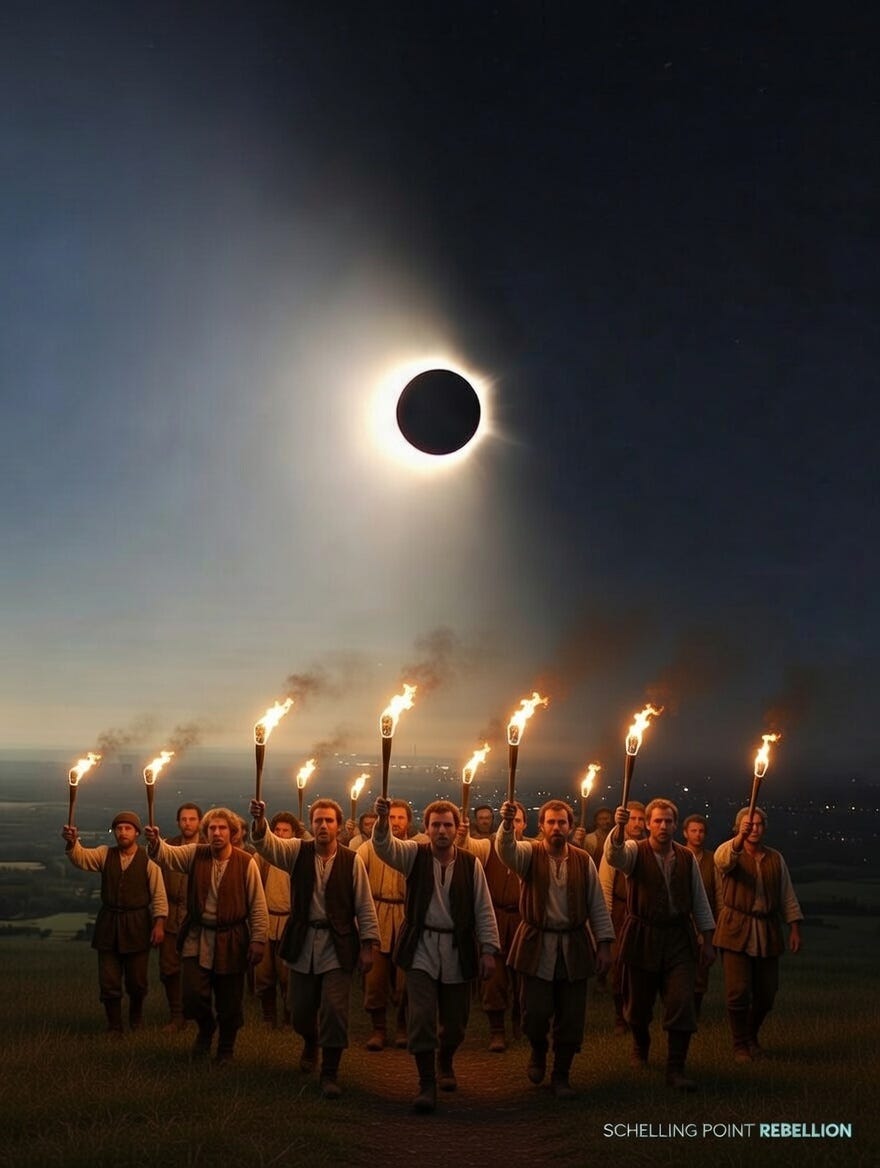
So how do you use an eclipse to foment a rebellion? One idea is to spread the belief that an eclipse means that change is coming, or a leader is about to fall ill, or really any sort of belief that makes the eclipse seem like a good time for everyone to rebel. It is not surprising, then, that there is evidence of these sorts of beliefs in China during this time. And so, during total eclipses, people believed that others saw the same thing—since it was high in the sky—and this created the focal point for a rebellion to begin. A sign, to rally the people, to bring them in line!
Rulers knew these ideas were out there, and there is evidence that they took precautions. For example, another recent paper, by Chen et al., suggests that during Chinese history, “emperors adopt an eclipse-dependent tax-cut strategy to reduce farmer rebellions.”1
The role that Schelling points play in coordinating action by many explains why places with more dramatic eclipses—locations where the eclipse is total rather than partial—rebelled more often. In those places, potential rebels knew that others saw the same dramatic dance in the sky, giving them greater confidence that others would take to the streets as well. In places with fewer eclipses, or places in which eclipses were only partial—the extent of an eclipse depends on where you are—people had less confidence that others would see the event as sufficiently dramatic to motivate rebellion.
Today, social media plays the same sort of role. When Elon Musk tweets something out on X, it’s a good bet that A) many people read the tweet and B) people who read the tweet believe that other people have read the tweet. Viral posts have the same property. If you see something on social media with millions of views, then you have evidence that many people have seen it.
The fact that social media platforms create common knowledge explains why they foment rebellions in the same way that eclipses do. They are both solving the same problem, the problem of common knowledge, or coordination. In the past, you could stand in the town square and yell, hey, let’s kill the baron and build a government of and by the people or whatever, but your reach was limited to how far your voice carried. Now, of course, your voice can reach millions, as tweets and other posts are amplified.
It’s important to note that the issue isn’t just that social media gets information out there so that everyone has access to it. There must be common knowledge. The usual example of this is The Emperor’s New Clothes. Everyone sees that the king is naked. But no one dares say anything until the child takes the belief to level 3, common knowledge. Broad dissemination of information is not in itself sufficient.
The paper I linked to above, “Social Media and Collective Action in China,” shows how social media posts spread protests and strikes. The fact that the research targeted China is important. There, the government, well aware of the power of the internet in general and social media in particular, exercises control over content, censoring material that might be dangerous. Nonetheless, even with these controls in place, these platforms do manage to foment unrest.
Governments have been aware of the role that social media might play in rebellions right from the start. For an excellent account, see Sarah Wynn-Williams’ book, Careless People: A Cautionary Tale of Power, Greed, and Lost Idealism. From her front row seat at facebook, she witnessed how governments began to see the threat posed (and opportunity created) by facebook and other social media platforms and reacted to it by working to control their power to bend them to their own ends. This trend continues to this day, as authoritarian regimes suppress the spread of information during times of instability by restricting the use of some or all of the internet for its citizens.
Now, what about the strong claim in the title, that eclipses caused rebellion. Causality is a notoriously difficult concept to establish. And, of course, the fact that rebellion correlates with eclipses doesn’t, in itself, establish causality.
Still, the fact that some regions experienced total eclipses more than others is pretty close to random assignment. Those regions might be different from other regions in systematic ways, but eclipses don’t respect human-drawn boundaries, so that doesn’t seem too likely. And, of course, it’s not just that those regions rebelled more often, it’s that they did so around the time of eclipses. This finding suggests that if it hadn’t been for the eclipse, there would have been no rebellion, showing but-for causality. But for the eclipse, the rebellion would not have occurred.
Rebellions are difficult without a Schelling point. Recently, the Wall Street Journal published an editorial by Babak Seradjeh about the massive demonstrations in Iran. Referring to the son of the former ruler of Iran, Shah Mohammed Reza Pahlavi, Seradjeh writes: “Mr. Pahlavi called on Iranians to turn out, and they responded en masse. My family in Tehran described a stream of people suddenly pouring into the streets on Jan. 8 at 8 p.m., the exact time of Mr. Pahlavi’s call. The arteries of the capital and other major cities pulsated with people. The regime cut off the internet and responded with unprecedented violence.”
In this brief passage, we see all the pieces to the puzzle: the attempt to provide a Schelling point for rebellion, people answering that call, presumably believing that others will as well, and the crackdown by authorities to undermine coordination through social media.
Chen et al. suggest that the relationship between celestial events and rebellion has deep historical roots, writing that in “the Bamboo Annals (zhushu jinian), a chronicle of early China, recorded an eclipse in 1059 BC that was interpreted by a vassal king, Wen of the Zhou Dynasty, as a sign to challenge his cruel overlord.”
Humans have been looking to the sky for Schelling points since time immemorial.
Note that other dramatic events—floods, droughts, earthquakes—don’t play the same role that eclipses do. You might have thought they would, given that they are also dramatic. However, floods and famine are distributed and uneven. An earthquake may devastate one town while leaving the next untouched. When some disasters occur, people know something bad happened, but they might not know that others know that it did. Eclipses, by contrast, are synchronized, unmistakable, and publicly shared.
Very interesting example of common meta knowledge solving coordination problems. Thanks for writing such a cool article!
Very nice! These days we still get some good eclipse watching parties